
Why the Chicago Corridor Is the Hardest Place in America to Find Truck Parking
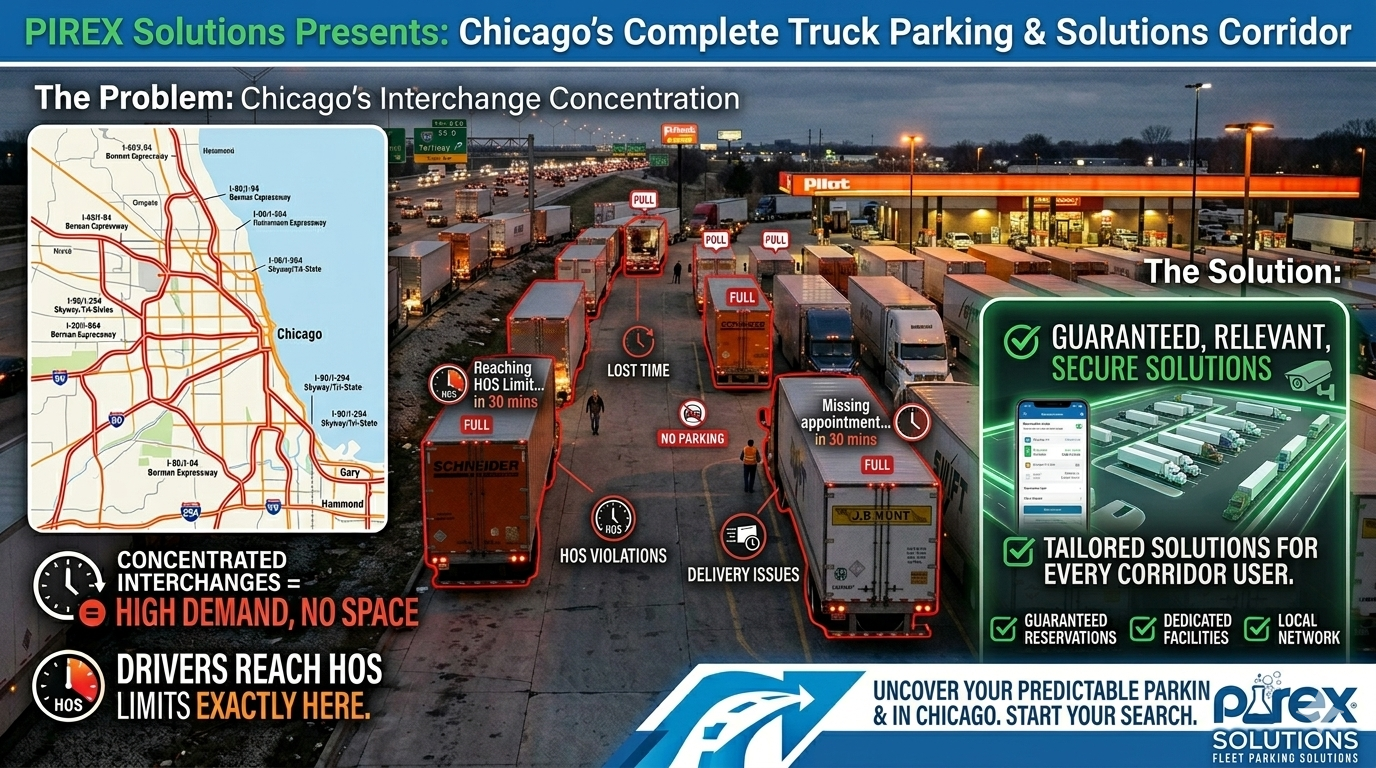
The Midwest is the beating heart of American freight.
And at the center of that system sits Chicago.
Every day, thousands of trucks move through the northern Illinois and northwest Indiana freight lanes connecting the East Coast, West Coast, and the South. The majority of those trucks pass through three of the most critical highways in the United States:
Interstate 80
Interstate 90
Interstate 94
These corridors form one of the largest freight interchange zones in North America.
But for CDL drivers trying to finish their day legally and safely, the Chicago corridor has become something else entirely:
The hardest place in America to find truck parking.
What most people outside the industry don’t realize is that the geography of this freight network creates a perfect storm — one where drivers arrive needing parking at exactly the same time, in a region that was never built to support them.
America’s Largest Freight Crossroads
Few places in the country see the same concentration of truck traffic as northern Illinois and northwest Indiana.
Major national routes converge here, including:
Interstate 55
Interstate 65
Interstate 57
Interstate 294
This network funnels long-haul freight between key logistics hubs such as:
Indianapolis
Detroit
St. Louis
Kansas City
Minneapolis
Because of this connectivity, the Chicago region handles more truck freight than almost any other metro area in the country.
But this density creates a hidden operational problem.
Drivers often arrive in the region late in the afternoon or early evening, exactly when their Hours of Service (HOS) clocks are about to expire.
Which means thousands of drivers begin searching for parking at the same time.
The “Parking Collapse Window”
Most truck stops around the Chicago freight belt follow a predictable pattern.
Parking begins filling around 4:30–5:00 PM.
By 6:00 PM, many facilities along the major corridors are already full.
After that point, drivers are left searching farther and farther away from the highway network.
This is what many drivers call the parking collapse window.
During this time, parking availability disappears across the entire region.
Drivers then face a chain reaction:
Truck stops fill completely
Rest areas overflow
Industrial streets become improvised parking zones
Highway shoulders become last-resort stops
Anyone who has driven through the Chicago freight lanes at night has seen it.
Rows of trucks parked wherever space exists.
None of it was planned that way.
Why the Chicago Region Has So Little Parking
There are several structural reasons why the Chicago corridor has become such a difficult place to park.
1. Land Costs
Northern Illinois is one of the most valuable logistics real estate markets in the country.
Industrial land near highways is prioritized for:
Warehouses
Distribution centers
Intermodal yards
Dedicated truck parking rarely generates the same revenue per acre.
As a result, very little new parking infrastructure gets built.
2. Zoning Restrictions
Many municipalities around the Chicago freight belt limit where trucks can park overnight.
Local governments often try to prevent truck traffic from spilling into residential areas.
While understandable, these restrictions reduce the number of legal parking options even further.
3. Explosive Freight Growth
Over the last two decades, the rise of e-commerce and regional distribution has dramatically increased truck traffic through the Midwest.
Yet the truck parking infrastructure has barely expanded.
The result is a system where demand continues to grow while supply remains almost frozen in place.
Why This Corridor Hits Drivers at the Worst Possible Time
The Chicago corridor also happens to sit about one full driving shift away from several major freight hubs.
For example:
Kansas City → Chicago is roughly a full driving day
Nashville → Chicago is close to a full shift
Memphis → Chicago lands drivers near the end of their clock
That means drivers approaching the region often arrive with very little HOS time remaining.
Instead of finishing their shift smoothly, they suddenly need to begin hunting for parking inside one of the most congested freight environments in the country.
The Cost to Drivers
When parking becomes unpredictable, drivers start adjusting their day around the problem.
Many drivers begin searching one to two hours early just to secure a spot.
This creates:
Lost miles
Reduced income
Schedule compression for the next day
Drivers may also risk:
HOS violations
Illegal parking tickets
Unsafe roadside stops
For owner-operators and small fleets, these inefficiencies directly impact revenue.
Why Private Truck Parking Networks Are Emerging
Because public infrastructure has not kept pace with freight demand, a new model is starting to appear across the industry.
Private truck parking networks are beginning to develop dedicated facilities along high-volume freight corridors.
These networks allow drivers and fleets to:
Secure guaranteed parking
Plan stops in advance
Avoid nightly parking searches
Stay compliant with HOS regulations
Instead of hoping for an open space, drivers know exactly where they’re stopping.
A Network Built Specifically for the Chicago Corridor
The Chicago freight region is exactly the type of environment where structured truck parking networks make the biggest difference.
Rather than relying on scattered truck stops, corridor-based parking systems place secured facilities directly along the routes drivers already run.
For drivers traveling through the Midwest freight belt, this turns the end of the day from a guessing game into a predictable stop.
And in a corridor where thousands of trucks are competing for the same limited spaces every evening, predictability becomes extremely valuable.
The Bottom Line
The highways surrounding Chicago move an enormous portion of the country’s freight.
But the region’s truck parking infrastructure has not kept pace with that growth.
When thousands of drivers converge on the Interstate 80, Interstate 90, and Interstate 94 corridors every evening, the system simply runs out of space.
The result is one of the most difficult parking environments in the United States.
Until more dedicated infrastructure is built, drivers moving freight through the Midwest will continue facing the same nightly challenge:
Finding somewhere safe and legal to stop before their clock runs out.