
What Happens to Your Cargo When You Can’t Find Safe Parking — And Who Is Liable
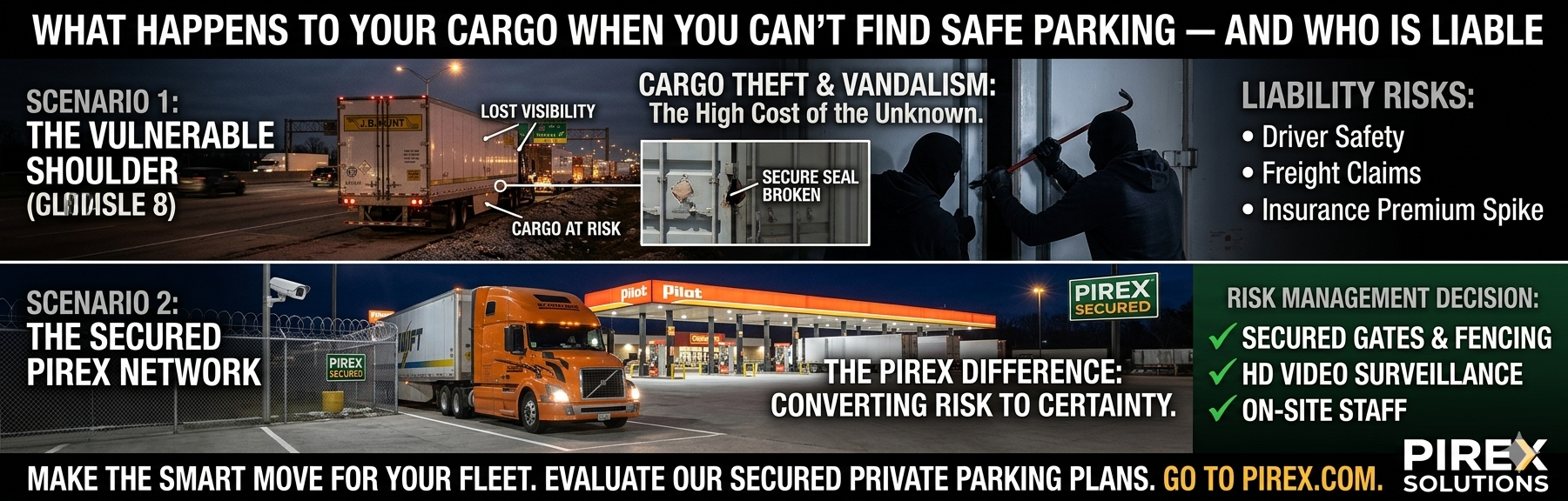
Every truck driver knows the moment.
The clock is almost out. The nearest truck stop is already full. The rest area twenty miles back had trucks lined up along the ramp. The next exit might have space — or it might not.
So the driver does what thousands of drivers do every night across the country.
They park wherever they can.
A highway shoulder.
An empty lot behind a closed business.
A quiet industrial street.
An unlit corner of a warehouse district.
The trailer doors stay shut. The cab goes dark. The driver tries to sleep.
But the cargo behind those doors — often worth hundreds of thousands of dollars — is now sitting in a place it was never meant to be.
And when something goes wrong, the question that follows is rarely simple.
Who is responsible?
The Quiet Rise of Cargo Risk
Cargo theft has long been a concern within the trucking industry, but in recent years it has evolved into something more organized and more opportunistic.
Professional theft rings increasingly monitor freight patterns, distribution hubs, and transportation corridors. But many thefts are not elaborate operations at all. They happen because a truck is left exposed in a vulnerable location.
The pattern is familiar.
A driver, unable to find legitimate parking near the end of a shift, pulls into an unsecured area for the night. There are no cameras, no fencing, no gate access. Sometimes there isn’t even adequate lighting.
In these conditions, a trailer becomes less like a moving part of a logistics network and more like an unattended warehouse.
For thieves, it is an invitation.
The Most Vulnerable Parking Situations
Not every parking location carries the same level of risk. Some places, however, repeatedly appear in cargo theft reports and insurance claims.
Highway Shoulders
Parking along highway shoulders is one of the most visible signs of the truck parking shortage. But it also leaves both driver and cargo exposed. Passing traffic can easily observe trailers sitting unattended for hours.
Unsecured Industrial Lots
Empty commercial lots often appear safe at first glance. But without active businesses nearby, they provide cover for individuals who know exactly what they are looking for.
Closed Retail Parking Areas
Large retail lots can appear attractive because of their size and accessibility. Yet overnight security is often minimal, and businesses rarely authorize trucks to remain there long-term.
Unauthorized Warehouse District Parking
In dense logistics zones, trucks sometimes park along curbs or unused loading areas. These areas can attract unwanted attention precisely because freight traffic is expected there.
The problem is not only theft.
Vandalism, trailer break-ins, and unauthorized access can all occur when cargo sits unprotected.
When Something Goes Wrong
When cargo is damaged, stolen, or compromised overnight, the investigation that follows quickly becomes complicated.
Responsibility can fall across several parties.
The Driver
Drivers may be questioned about where and why the truck was parked. If the location violated company policy or safety guidelines, the driver’s decision can come under scrutiny.
The Carrier
Carriers are responsible for the safe transportation of freight from origin to destination. Insurance providers and shippers often examine whether reasonable precautions were taken to protect the load.
The Shipper or Broker
Depending on contract language, liability can extend to the shipper or freight broker if security expectations were clearly defined within the transportation agreement.
These situations often turn on a single question:
Was reasonable care taken to protect the cargo?
And when a trailer is found sitting overnight on a highway shoulder or in an unmonitored lot, that question becomes harder to answer.
Insurance Doesn’t Always Mean Protection
Many carriers assume that cargo insurance automatically covers any loss that occurs during transit.
In reality, coverage often depends on the circumstances surrounding the incident.
Insurance investigators may ask:
Was the trailer parked in an authorized location?
Were reasonable security precautions taken?
Was the area known for theft activity?
Were there safer parking alternatives available?
If investigators determine that a load was left in a high-risk or unauthorized location, claims can become contested or partially denied.
Even when insurance ultimately pays, the process can involve weeks of documentation, investigation, and operational disruption.
The Cost Beyond the Cargo
The financial loss of stolen freight is only the beginning.
The ripple effects can include:
Missed delivery deadlines
Contract disputes with shippers
Insurance premium increases
Damage to carrier reputation
For owner-operators, a single cargo incident can threaten relationships with brokers and customers.
For fleets, repeated claims can affect insurance eligibility and long-term operating costs.
What begins as a simple parking problem can evolve into a risk management problem affecting the entire operation.
Why the Parking Shortage Creates Exposure
The underlying issue remains the same: drivers often do not have reliable parking available when they need it.
Federal Hours of Service regulations limit how long a driver can operate before taking a required rest period. When parking options are exhausted, drivers must choose between stopping early, driving farther than planned, or parking in less secure locations.
In freight-heavy corridors such as the Midwest distribution belt, this situation plays out nightly as thousands of trucks converge on the same limited parking infrastructure.
The result is a predictable pattern: high-value cargo parked in locations that were never designed to secure it.
A Shift Toward Secured Parking Infrastructure
As cargo theft and liability exposure become more visible, some carriers and drivers are beginning to approach parking differently.
Instead of treating it as the last decision of the day, they treat parking as part of the route plan itself.
Secured private truck parking facilities are emerging along major freight corridors to address exactly this issue.
These facilities typically include:
Controlled gate access
Fenced perimeters
Lighting and monitoring systems
Dedicated truck-only spaces
For carriers, the benefit is not simply convenience. It is risk reduction.
When a trailer is parked in a controlled environment designed for freight vehicles, the operational and legal picture changes significantly.
Drivers know where they will stop before the shift begins. Fleet managers know where their equipment and cargo will sit overnight.
And if an incident occurs, documentation of secure parking practices can become an important part of demonstrating responsible cargo handling.
The New Parking Question
For decades, the trucking industry has treated parking as an inconvenience — a nightly challenge drivers must solve on their own.
But as cargo values increase and theft networks grow more sophisticated, the question is beginning to shift.
Parking is no longer only about where a driver sleeps.
It is about where hundreds of thousands of dollars in freight spend the night.
A Practical Decision for Fleets and Drivers
For fleet managers and owner-operators alike, the calculation is becoming clearer.
Unsecured parking introduces variables that can affect safety, compliance, and liability.
Secured parking, on the other hand, removes uncertainty from one of the most vulnerable parts of a freight journey.
It turns the end of a driver’s day into something predictable — and protects the cargo that keeps the industry moving.
In a freight economy built on precision and reliability, that shift is no longer just a convenience.
It is a decision about risk.