
America's Truck Parking Crisis Is Creating a Rare Opportunity for Landowners
Millions of acres of underutilized commercial land sit idle across the U.S. — while trucking companies desperately search for safe, reliable parking. Here's how forward-thinking property owners are turning unused space into recurring revenue.
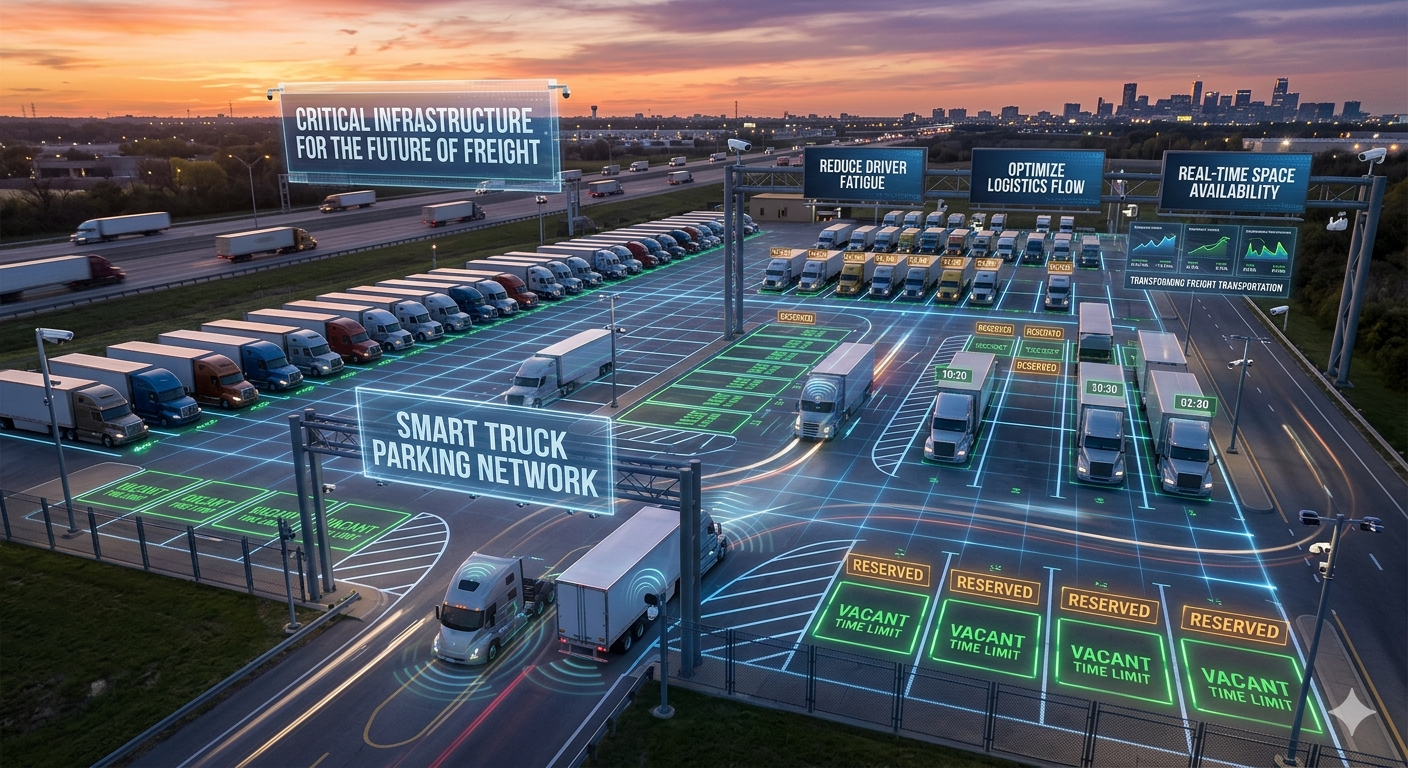
Every night, thousands of professional truck drivers pulling freight across the country face the same frustrating question: where am I legally allowed to stop?
It's not a minor inconvenience. Federal hours-of-service regulations require drivers to stop once they hit their legal limit — no exceptions. When safe, accessible parking isn't available, drivers are forced into dangerous roadside pull-offs, risk expensive violations, or push their schedules in ways that compromise safety and compliance.
Meanwhile, millions of acres of commercial and industrial land across the U.S. sit underused — vacant lots near interstates, unused parcels adjacent to distribution hubs, excess acreage tied to existing businesses. These properties have long been viewed as maintenance burdens. That perception is changing fast.
"A vacant industrial parcel near a major highway may no longer be an unused property. It may be future logistics infrastructure."
Why the truck parking shortage is getting worse
American freight volumes have grown steadily for decades, driven by e-commerce, just-in-time manufacturing, and increasingly complex supply chains. The trucking industry moves roughly 72% of all domestic freight by tonnage — food, medical supplies, retail goods, construction materials, and consumer products all depend on it.
But while freight demand has surged, the infrastructure that supports drivers — particularly parking — has not kept pace. The result is a structural gap: too many trucks, not enough places to stop.
Drivers regularly encounter:
Overcrowded truck stops with no available space
Rest areas that fill to capacity by early evening
Unsafe roadside shoulder parking as a last resort
Costly parking violations in unauthorized zones
Delayed deliveries disrupting supply chain schedules
For trucking companies, this creates real operational and financial pain. For landowners near freight corridors, it creates an opening.
Location is still everything — and freight corridors are the new premium zones
The same principle that has always driven real estate value applies directly to logistics infrastructure: location determines potential. A property near a major highway interchange, distribution center, port, or rail hub carries significantly more strategic value than it might appear on a typical appraisal.
Properties near the following generate the strongest demand for commercial truck parking:
Interstate highways
High-volume freight corridors where drivers need stopping options every few hours.
Distribution centers
Drivers staging for load windows or off-hours appointments need nearby parking.
Ports and rail
Intermodal hubs create dense, concentrated demand for overnight and short-term truck parking.
Manufacturing zones
Inbound and outbound freight for industrial facilities requires flexible staging options.
A piece of land that generates little or no income today can become a consistent revenue-producing logistics asset — without requiring warehouse construction or complex development.
What modern truck parking facilities actually look like
Converting underused land into a truck parking operation doesn't mean gravel and a chain-link fence. Today's fleets and professional drivers expect facility standards that match the professionalism of their operations. Smart operators invest in infrastructure that builds loyalty and justifies premium pricing.
Secure access and vehicle monitoring
Controlled entry systems, secure gating, and digital access management are no longer optional add-ons — they're the baseline expectation for fleets moving high-value cargo. A facility that demonstrates security competence becomes the default choice for repeat bookings.
Lighting and driver safety
Drivers arrive at all hours. LED lighting throughout the facility, clear lane marking, visible signage, and well-maintained surfaces create the kind of environment drivers return to — and recommend to colleagues. A safe facility is a full facility.
Technology-driven management
Modern logistics runs on data and automation. Paper-based payment and phone reservations signal to fleet managers that a facility isn't ready for professional clients. Technology platforms that manage space availability, accept digital reservations, automate billing, and provide usage reporting are increasingly the expectation — not the exception.
The competitive edge is in the details
Facilities that combine reliable security, good lighting, and seamless digital booking outperform those offering space alone. Drivers and fleet managers talk — a well-run facility fills through reputation as much as marketing.
How truck parking generates recurring, predictable revenue
One of the most significant advantages of commercial truck parking as a business model is its compatibility with subscription and contract structures. Unlike transactional parking, well-operated facilities can build stable, predictable income through:
Monthly parking memberships for individual drivers
Fleet agreements with trucking companies securing blocks of spaces
Long-term contracts with shippers and logistics providers
Reserved space packages for premium, guaranteed access
Trailer storage programs for fleet asset management
Trucking companies don't pay for a parking spot. They pay for certainty — the guarantee that when a driver reaches their hours-of-service limit, there's a secure, accessible place waiting for them. That reliability carries real monetary value in an industry where delays cascade through entire supply chains.
This creates a fundamentally stronger business model than traditional parking, where revenue depends entirely on day-to-day occupancy.
Logistics real estate is evolving — and parking is the missing piece
The commercial real estate investment world has spent years focused on warehouses and distribution centers. That attention has driven up values and compressed yields in those segments. But the broader logistics ecosystem requires more than storage — it needs connected infrastructure that keeps freight moving efficiently.
Truck parking is the part of that infrastructure that has lagged furthest behind demand. Properties that help close that gap are increasingly recognized as legitimate logistics real estate — not overflow land, but strategic assets.
The next generation of freight infrastructure may not always be a new building. Sometimes it begins with land that already exists, repositioned to serve the network that runs through it.
"The companies that solve overlooked problems will shape the future. Truck parking is one of those problems."
How Pirex Solutions helps property owners get there
Transforming unused land into a functioning truck parking operation requires more than a cleared lot. It requires the right technology, customer relationships, operational systems, and ongoing management — infrastructure most landowners aren't positioned to build from scratch.
Pirex Solutions works with property owners to build and manage modern, technology-driven commercial truck parking facilities. That means connecting landowners with the fleets and drivers actively searching for parking, deploying the management platforms that make operations scalable, and handling the day-to-day systems that keep facilities running and revenue flowing.
The goal is straightforward: turn underutilized space into organized, revenue-generating logistics infrastructure — with the technology and fleet relationships already in place to make it work from day one.
Is your property near a freight corridor?
Find out if your land qualifies for a commercial truck parking conversion. Pirex Solutions connects property owners with the demand, technology, and operational support to make it happen.