
The Truck Parking Crisis Is Getting Worse — Here’s What No One Is Telling You
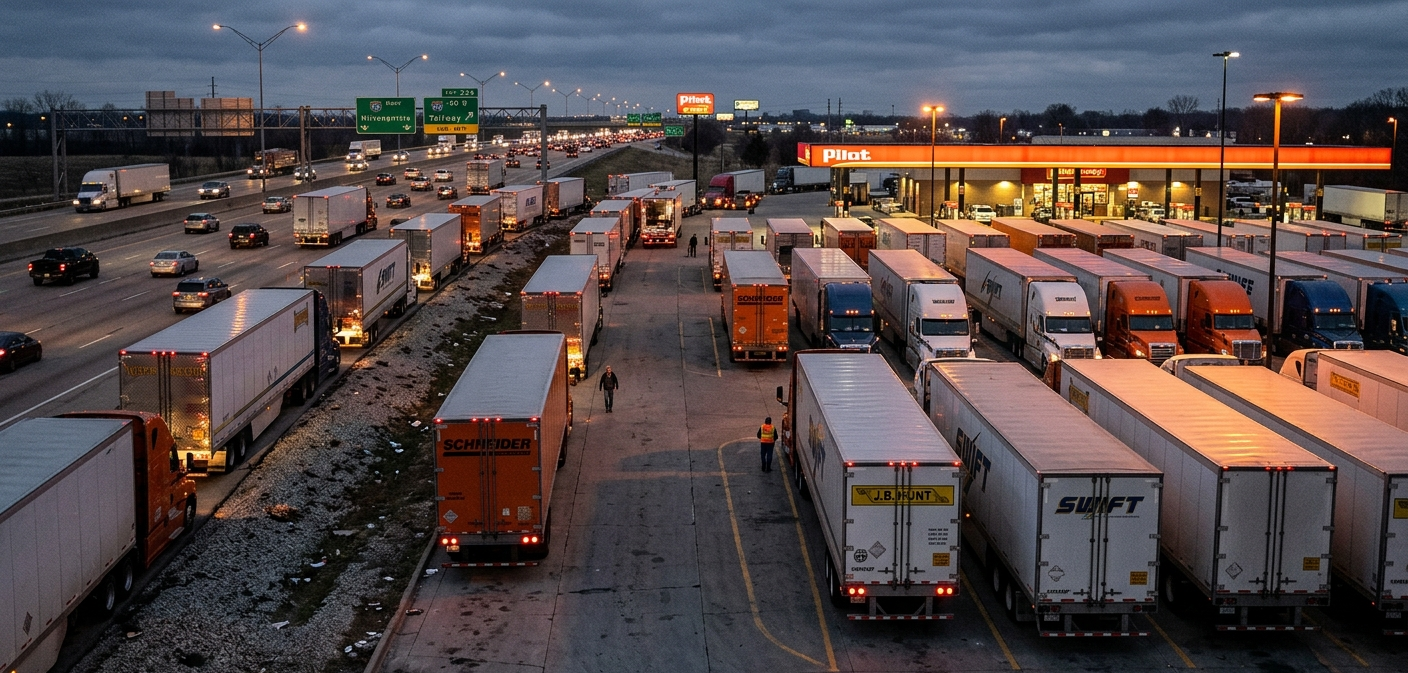
The American trucking industry moves nearly everything we depend on. From groceries and medicine to construction materials and retail goods, over 70% of freight in the United States travels by truck. Yet the drivers responsible for moving the economy face a problem that continues to worsen every year: there is nowhere safe to park.
What many people outside the industry don’t realize is that truck parking is no longer just an inconvenience — it has become a systemic infrastructure failure affecting safety, driver retention, freight efficiency, and the overall cost of goods.
Across the United States, the shortage of available truck parking spaces is estimated to exceed 300,000 spaces nationwide, and nowhere is the pressure felt more than along the major freight corridors running through the Midwest.
But the real story goes deeper than the shortage itself.
The 300,000-Space Shortage
According to industry studies and transportation research groups, the United States currently has one legal truck parking space for every 11 trucks on the road.
That imbalance creates a daily logistical challenge for drivers who must comply with federal Hours of Service (HOS) regulations that dictate how long they can drive before taking mandatory rest breaks.
In theory, drivers should be able to plan their stops.
In reality, parking availability often determines when and where they stop — not their route plan.
Many drivers begin searching for parking two to three hours before their driving clock expires, simply because they know space will be nearly impossible to find later in the evening.
This means valuable driving time is lost every single day.
Why Public Rest Areas Stopped Being the Solution
For decades, state-operated rest areas were considered the primary parking option for long-haul drivers.
Today, they are no longer sufficient.
Most state rest areas were designed decades ago when truck traffic was dramatically lower. Freight volume has surged in the past 30 years, but rest area capacity has barely changed.
In fact, some states have actually closed rest areas due to maintenance costs or land constraints.
Even when rest areas are open, they typically fill up by early evening — sometimes as early as 5:00 PM along major freight routes.
Once they fill up, drivers are forced to improvise.
You’ll see trucks parked:
On highway shoulders
In abandoned lots
At closed businesses
On entrance ramps
In unsafe industrial zones
None of these are safe. Many aren’t even legal.
The Hidden Cost to CDL Drivers
The truck parking crisis carries a real financial cost for drivers — one that rarely shows up in industry headlines.
When a driver is forced to stop early because they found parking, they lose miles they could have legally driven.
Let’s break down a common scenario.
A driver begins searching for parking 90 minutes before their HOS clock expires.
If they normally average 60 mph, that means they are losing:
90 miles per day
For drivers paid per mile, this is lost income.
Assuming a conservative rate of $0.60 per mile, that equals:
$54 lost per day
Over a five-day workweek, that becomes:
$270 in lost earnings
Over a full year of driving, the number grows to over $13,000 in potential income lost simply because parking wasn’t available.
And that doesn’t even account for additional costs like:
Detours searching for parking
Idling fuel while waiting for spaces
Late delivery penalties
Safety risks and stress
The Compliance Problem
The parking shortage also puts drivers in an impossible position when it comes to compliance.
Federal HOS regulations are strict — once a driver’s clock expires, they must stop driving.
But what happens when there’s nowhere to park?
Drivers are left with three choices:
Continue driving and risk an HOS violation
Park illegally and risk a ticket or towing
Stop hours early and lose income
None of these are good options.
For many drivers, the decision becomes a daily gamble between safety, legality, and livelihood.
Why the Midwest Is Ground Zero
The Midwest sits at the heart of the national freight network.
Major corridors such as I-80, I-70, I-55, I-65, and I-94 carry massive volumes of long-haul freight connecting the East Coast, West Coast, and Southern distribution hubs.
Cities like Chicago, Indianapolis, Kansas City, and St. Louis function as critical logistics crossroads.
Yet the amount of dedicated truck parking infrastructure along these corridors has not kept pace with the growth in freight demand.
This makes the region one of the most difficult places in the country for drivers to reliably secure parking.
Why Private Infrastructure Is Emerging
Because government investment has lagged behind freight growth, a new model is starting to emerge.
Private logistics infrastructure companies are beginning to develop secured truck parking networks along major freight routes.
These facilities offer:
Gated access
Verified parking reservations
24-hour availability
Dedicated capacity for drivers and fleets
Instead of searching blindly for parking at the end of a shift, drivers can plan their stop before they even begin the day’s route.
For fleets, this also reduces compliance risk and improves delivery reliability.
The Industry Is Reaching a Breaking Point
Driver turnover remains one of the biggest challenges in the trucking industry.
Parking stress is consistently cited by drivers as one of the top quality-of-life issues in long-haul trucking.
When drivers spend hours every week simply trying to find somewhere safe to park, it affects:
Safety
Earnings
Work-life balance
Job satisfaction
Without new infrastructure solutions, the problem will only get worse as freight demand continues to grow.
The Bottom Line
The truck parking shortage is not a minor inconvenience — it is a national logistics bottleneck hiding in plain sight.
With a deficit of more than 300,000 spaces nationwide, drivers are forced into unsafe and inefficient decisions every single day.
Public rest areas alone cannot solve the problem.
New infrastructure, smarter networks, and private-sector innovation will likely play a major role in closing the gap.
Until then, the people who keep the American economy moving will continue to face the same nightly question:
Where am I supposed to park tonight?